
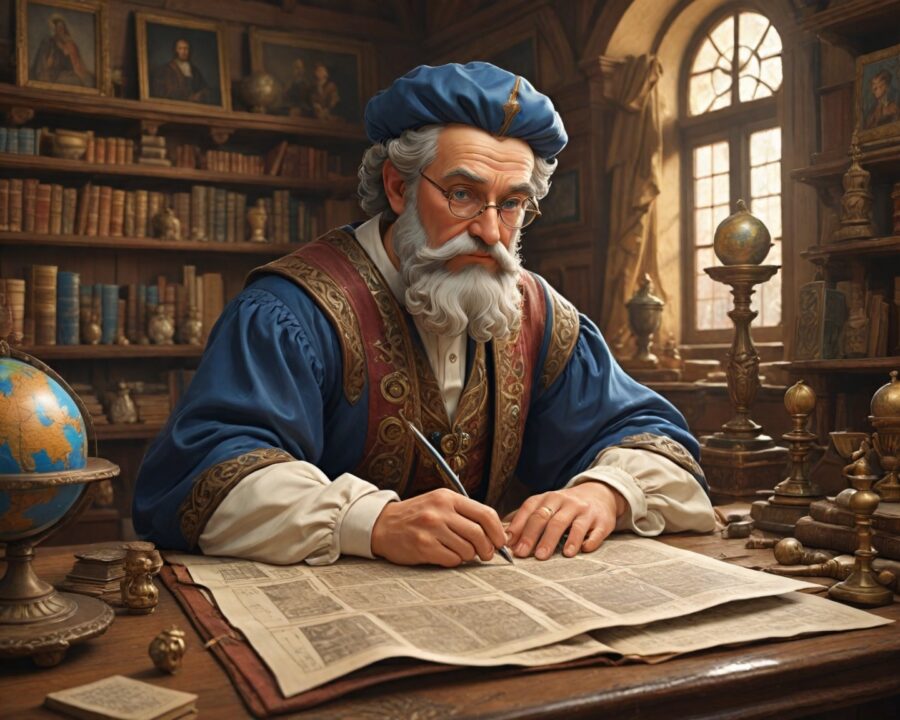
Introduction to the Renaissance Era
The Renaissance era, a period in European history, marks the transition from the Middle Ages to modernity, and it spans roughly the 14th to the 17th century. Emerging after the bleak times of the Middle Ages, the Renaissance was a cultural awakening. The term “Renaissance,” meaning “rebirth” in French, accurately captures the revival of interest in the classical learning and wisdom of ancient Greece and Rome. This era is revered for its monumental contributions to art, architecture, politics, science, and literature, sparking an unprecedented surge of creativity and thought that laid the groundwork for the modern Western world.
Producing iconic figures such as Leonardo da Vinci, Michelangelo, and Galileo Galilei, the Renaissance left an indelible mark on human history. It was characterized by a humanistic revival of classical influence expressed in art and literature, a flowering of scientific inquiry, and a renewed approach to individualism and critical thinking. This article will explore the multifaceted dimensions of the Renaissance, from key historical events and major figures to its lasting impact on modern society, debunking common misconceptions and providing practical ways to engage with Renaissance history today.
Key Historical Events During the Renaissance
The Renaissance was propelled by significant historical events that collectively framed its narrative and transformational nature. It is generally accepted that the early period of the Renaissance began in Florence, Italy, around the late 14th century, spurred by the Medici family, who were great patrons of the arts and humanistic studies. Florence’s unique political structure, wealth, and access to Mediterranean trade routes allowed it to be a hub of commerce and cultural innovation.
Another pivotal event was the fall of Constantinople in 1453, which led to the migration of Greek scholars to Italy. This revived interest in Greek and Roman texts and sciences, blurring the lines of regional intellectual boundaries. Furthermore, the invention of the printing press by Johannes Gutenberg in 1440 revolutionized the dissemination of knowledge, making books more accessible and affordable to a broader audience, which in turn catalyzed the educational growth of Europe.
The Protestant Reformation, initiated by Martin Luther’s 95 Theses in 1517, also occurs during this period, bringing religious reforms that challenged the Catholic Church’s historical power. This movement fundamentally altered the religious landscape of Europe, leading to centuries of religious conflicts but also increased religious pluralism.
Major Figures of the Renaissance Period
The Renaissance was enriched and driven by numerous influential figures whose works and ideas drastically shifted the course of history. These individuals spanned various fields, including art, science, literature, and politics.
Leonardo da Vinci epitomizes the Renaissance Man with his insatiable curiosity and multi-disciplinary talent. Known for masterpieces like the “Mona Lisa” and “The Last Supper,” da Vinci also pursued studies in anatomy, engineering, and mechanics, leaving behind comprehensive journals that illustrate the breadth of his intellect.
Michelangelo Buonarroti, another towering figure, left an indelible legacy with his sculpture “David” and the awe-inspiring frescoes on the ceiling of the Sistine Chapel. His artistic achievements reflected the humanist ideals of the Renaissance, emphasizing the beauty and complexity of the human form.
Galileo Galilei’s contributions to science were monumental. Often regarded as the father of modern observational astronomy, Galileo advanced the telescope’s design, enabling him to make unprecedented astronomical observations. His advocacy for the Copernican model of the solar system led to significant controversy with the Catholic Church, but his work laid the foundation for modern physics and astronomy.
The Role of Art and Culture in the Renaissance
Art and culture were central to the Renaissance, marking a departure from the purely religious themes prevalent during the Middle Ages. Artists and thinkers rediscovered classical ideals, which they adapted into new forms that celebrated human experience and realism.
Renaissance art is characterized by realism, perspective, and attention to detail. Techniques like chiaroscuro (the use of light and shadow) and linear perspective were developed, giving depth and life to paintings. Artists like Sandro Botticelli, whose work “The Birth of Venus” symbolizes the marriage of classical and contemporary themes, played a pivotal role in showcasing the innovative potential of Renaissance art.
Literature also flourished during this period, with figures like Dante Alighieri, whose “Divine Comedy” isn’t just revered for its literary prowess but also for its philosophical insights. The works of William Shakespeare later in the Renaissance period continued this tradition with plays that explore the complexity of human nature.
Furthermore, the development of the printing press was essential for the proliferation of cultural knowledge. This technological advancement lowered the cost of book production, increasing literacy rates and making classical texts and contemporary works far more accessible to the European populace.
Scientific Advancements During the Renaissance
The Renaissance era is often celebrated as an age of great scientific advancement. This period witnessed a move away from the Aristotelian and Ptolemaic views that had dominated medieval thought, as scholars began to adopt more empirical methodologies.
Nicolaus Copernicus was a pioneering astronomer whose heliocentric model of the solar system challenged the long-established geocentric theory. His work, “De revolutionibus orbium coelestium,” published posthumously in 1543, paved the way for future astronomers like Galileo and Johannes Kepler, who expanded on his ideas about planetary orbits.
In the realm of biology and medicine, Andreas Vesalius’s “De humani corporis fabrica” (On the Fabric of the Human Body) revolutionized anatomical study. Vesalius advocated for direct observation and dissection of corpses, providing a more accurate depiction of human anatomy than ever before.
The era also saw significant advancements in engineering and navigation. Leonardo da Vinci’s conceptual designs for machines, although never built in his lifetime, would anticipate future inventions like helicopters and tanks. Meanwhile, improved shipbuilding techniques and navigational tools facilitated explorations that led to critical geographic discoveries, bridging continents and cultures.
The Impact of the Renaissance on Modern Society
The Renaissance undeniably set the stage for the modern age, with its influences permeating multiple aspects of contemporary life. By reviving classical learning and thought, the Renaissance equipped European societies with new methodologies for inquiry and innovation.
In governance and political thought, the period saw the rise of modern nation-states and the development of political philosophy heralded by figures like Niccolò Machiavelli, whose work “The Prince” remains a crucial text for understanding political strategy and power dynamics.
Culturally, the Renaissance’s emphasis on humanism continues to underpin much of Western thought, promoting values like secularism and individualism. These principles resonate in today’s societal structures, where freedom of thought and expression is cherished and protected.
Moreover, the scientific methods and inquiries sparked during the Renaissance laid a groundwork for the scientific revolution and Enlightenment. Today’s technological advancements—a legacy of this—are predicated on principles first rigorously explored during the Renaissance era.
Common Misconceptions About the Renaissance
Despite its well-documented significance, the Renaissance is often misconstrued or overly simplified. One common misconception is that the Renaissance happened overnight. In reality, it was a gradual process spanning several centuries and regions, with various fluctuations in intensity and focus.
Another myth is that the Renaissance completely replaced medieval thought and life. Although it introduced new ideologies and artistic forms, many elements of medieval culture persisted alongside Renaissance transformations, blending into a more complex historical tapestry.
Additionally, some perceive the Renaissance as purely an Italian phenomenon. While Italy was indeed the epicenter, the Renaissance eventually influenced many parts of Europe, including the Northern Renaissance in countries like Germany, France, and England, each adding unique contributions to the movement.
How the Renaissance Shaped Education and Philosophy
Education underwent profound changes during the Renaissance, reflecting humanist principles that emphasized a well-rounded curriculum. This educational renaissance focused on a broad liberal arts education rather than the predominantly theological study that characterized medieval scholasticism.
Schools and universities began to incorporate a wider array of subjects, including the humanities, mathematics, natural sciences, and even physical education. Figures like Erasmus of Rotterdam championed this educational reform, advocating for the study of classical languages and philosophies to foster a more informed and ethical populace.
Philosophically, the Renaissance challenged long-held doctrines and encouraged a spirit of questioning and experimentation. Thinkers like Michel de Montaigne explored concepts of skepticism and subjective human experience, while Giordano Bruno expanded on ideas of the infinite universe, setting the stage for later philosophical developments during the Enlightenment.
Practical Ways to Explore Renaissance History Today
For those eager to delve into Renaissance history, numerous avenues are available to explore the era’s enduring legacy. One practical approach is visiting museums and art galleries worldwide that house Renaissance masterpieces. Institutions like the Uffizi Gallery in Florence, the Louvre Museum in Paris, and the Vatican Museums in Rome offer firsthand insights into the art and culture of the period.
Literature buffs might explore Renaissance texts by reading both the original works and modern interpretations. Many universities and academic institutions offer online courses and lectures about Renaissance history and culture, providing a more comprehensive understanding of the era.
Additionally, immersive experiences like Renaissance fairs and reenactments allow participants to gain a tactile understanding of the period through costumes, crafts, and performances, bringing the historical context to life vividly.
Conclusion: Why the Renaissance Era Still Matters
The Renaissance remains a pivotal Chapter in human history, not simply because of its artistic triumphs, but due to its contributions to shaping modern Western thought, culture, and scientific progress. Its legacy is woven into the fabric of contemporary life, influencing everything from our educational systems to our appreciation for art, literature, and innovation.
Understanding the Renaissance provides a window into the transformative power of human endeavor and the enduring potential for cultural and intellectual revolutions. This period serves as both a beacon and a blueprint, inspiring future generations to pursue wisdom, creativity, and progress with the same fervor demonstrated by history’s great Renaissance minds.
FAQ
What was the Renaissance?
The Renaissance was a cultural, artistic, scientific, and intellectual movement that marked the transition from the Middle Ages to modern history. It began in Italy in the late 14th century and spread throughout Europe, lasting into the 17th century.
Who were some significant figures during the Renaissance?
Significant figures of the Renaissance include Leonardo da Vinci, Michelangelo, Galileo Galilei, and Niccolò Machiavelli. These individuals contributed to fields such as art, science, politics, and literature, leaving lasting impacts on both their own era and future generations.
How did the Renaissance affect science?
The Renaissance significantly impacted science by moving away from Aristotelian thought and adopting empirical observation and experimentation. This period saw significant advances in astronomy, anatomy, and engineering, paving the way for the scientific revolution.
What role did art play in the Renaissance?
Art played a critical role in the Renaissance, reflecting the era’s humanist ideals and innovations in perspective and realism. Artists like Botticelli, da Vinci, and Michelangelo created works that celebrated human experience and beauty, and these masterpieces continue to influence and inspire art today.
How can I learn more about the Renaissance?
You can learn more about the Renaissance by visiting museums, attending lectures, reading literature from the period, and participating in reenactments or Renaissance fairs. Online courses also offer accessible pathways to delve deeper into various aspects of this fascinating period.
Recap
- The Renaissance was a key historical period marking the transition from medieval to modern times.
- It was characterized by a revival of classical learning, scientific advancements, and groundbreaking art.
- Key figures included Leonardo da Vinci and Michelangelo, who exemplified the Renaissance’s creative and intellectual innovations.
- The Renaissance continues to impact modern society in education, science, and philosophy.
- There are many practical ways to explore the Renaissance, from museums to literature to interactive experiences.
Conclusion
The Renaissance era’s imaginative and intellectual vigor laid much of the groundwork upon which modern Western culture builds. By rediscovering classical antiquity’s wisdom while simultaneously forging new paths in art, science, and philosophy, the Renaissance ignited a cultural flowering the likes of which the world had never seen. Its spirit of inquiry, exploration, and creativity still pulses through today’s society, reminding us of the heights human beings can achieve when curiosity and creative expression are allowed to flourish. As we engage with our own challenges and transformations, the Renaissance stands as a testament to the enduring power of human potential.