
Introduction to Greek mythology and its significance
Greek mythology, an enthralling collection of myths and legends, is a cornerstone of ancient Greek culture and continues to fascify people around the globe even today. These stories were more than just tales of adventure and intrigue; they were a way for the ancient Greeks to understand the world around them, explain natural phenomena, teach moral lessons, and preserve cultural traditions. Through compelling narratives of gods and goddesses, Greek mythology offered insights into human nature and the complexities of life, while also being an integral part of religious practices and community rituals. The myths not only illustrated the power struggles and relationships among deities but also depicted the human condition and societal values.
As we delve into the mythological universe of ancient Greece, we encounter a range of fascinating characters who play vital roles in the ancient Greek digital landscape. From the mighty Olympian gods residing on Mount Olympus to the formidable Titans who preceded them, these divine beings personify various aspects of life and nature. Understanding these myths and the characters within them not only enriches our knowledge of ancient Greek civilization but also offers timeless insights that resonate with contemporary society. This article will explore the pantheon of Greek gods and goddesses, their myths, and the enduring impact of these stories on both ancient and modern cultures.
Overview of the Olympian gods and their roles
The Olympian gods are central figures in Greek mythology, known for their residence atop Mount Olympus, the mythical home of the divine. There are twelve major Olympian gods, each presiding over different aspects of the natural and human world. They are primarily the children of the Titans Cronus and Rhea and have united under the leadership of Zeus, their supreme ruler. These gods and goddesses exhibit human-like traits, with emotions, conflicts, and relationships that mirror those of humankind.
Key among these Olympians is Zeus, the king of gods and the god of the sky and thunder. Next is Hera, his queen and sister, serving as the goddess of marriage and family. Poseidon, the brother of Zeus, reigns over the seas, while Demeter, their sister, governs agriculture and harvest. Among the younger generation, we find Apollo and Artemis, twin siblings who, respectively, govern the arts, healing, and the sun, and the hunt, wilderness, and the moon. Ares, the god of war; Athena, goddess of wisdom and warfare strategy; and Hephaestus, the divine smith and craftsman, are also members of this divine assembly.
Hermes, known for his speed, serves as the messenger of the gods and the deity of traders, while Dionysus governs wine and festivities. Finally, Aphrodite, known for her incomparable beauty, is the goddess of love and desire. The relationships and narratives surrounding these gods effectively capture human experiences and emotions, showcasing the Greeks’ attempts to explain their world and the experiences within it.
Key characteristics of Zeus, the king of gods
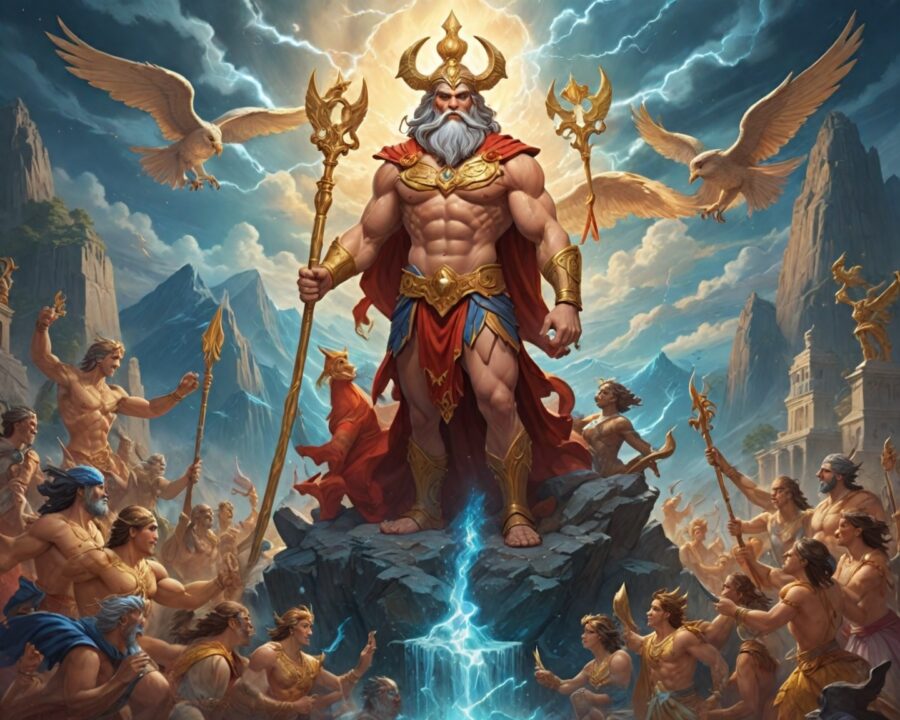
Zeus is the preeminent deity among the Greek gods and a central figure in many myths. As the god of the sky and thunder, he wields power over both the divine and mortal realms. Revered for his ability to maintain order and justice, Zeus commands respect and authority, often depicted with his iconic thunderbolt, a symbol of his power, and is frequently represented sitting on a majestic throne. His strength and unwavering authority cement his role as the ruler of both gods and humans.
Despite his esteemed position, Zeus is known for his complex personality, which includes a penchant for pursuing romantic interests. His numerous liaisons, both with other goddesses and mortal women, lead to the birth of many significant figures in Greek mythology, such as Athena, Hercules, and Persephone. These relationships highlight the human-like attributes of Greek deities, underscoring their emotions, desires, and often contentious interactions with one another. Zeus’s offspring often inherit aspects of his power and play crucial roles in various myths and legends.
Zeus’s involvement in human affairs and his interactions with other gods reveal his diplomatic and strategic acumen. He is frequently called to intervene in disagreements among gods and to mediate disputes among mortals. As an arbiter of justice, Zeus values fairness and often rewards those who demonstrate valor and integrity while punishing deceit and hubris. His powerful presence and dynamic persona have resonated through time, making Zeus one of the most recognizable figures in Greek mythology.
Hera, Athena, and Aphrodite: prominent goddesses
Hera, known as the queen of the gods, is the goddess of marriage and family. She is often depicted as a majestic figure sitting upon a throne, known for her beauty and regal bearing. Despite her complex relationship with Zeus, she is fiercely protective of her position and status. Hera is well-known for her role in punishing those who engage with her husband’s infidelities, revealing a persistent streak of jealousy and a protective nature towards her family. Her influence extends beyond her immediate domain, as she often takes an active role in the myths involving heroes, such as the Iliad, where she conspires against the Trojans.
Athena, Zeus’s daughter, represents wisdom, strategic warfare, and defensive war. Known for her strategic acumen and intelligence, Athena is often depicted wearing armor, a helmet, and holding a shield, with an owl, symbolizing wisdom, nearby. As a patroness of Athens, her iconic rivalry with Poseidon for control over the city gave rise to the legend of the olive tree, a gift she bestowed upon the city. Additionally, she played a crucial role in guiding heroes like Odysseus and Perseus, evidencing her importance and strategic support in various Greek narratives.
Aphrodite, the goddess of love, beauty, and desire, is one of the most celebrated Greek goddesses. Originating from a dramatic birth from sea foam, as detailed in the mythological account, her enchanting beauty has far-reaching implications in Greek myths. She is often portrayed as being irresistible to gods and mortals alike, with her tales of love involving breeding passion or turmoil, as exemplified by the story of the Trojan War. Aphrodite’s domain over love and attraction highlights the Greeks’ recognition of the powerful, multifaceted nature of romantic and erotic emotions.
The Titans and their connection to the Olympians
The Titans in Greek mythology are the precursors to the Olympian gods and hold a crucial place in the mythological hierarchy. Descendants of the primordial deities Uranus (Sky) and Gaia (Earth), the Titans ruled during the mythological Golden Age before the rise of the Olympian deities. They are generally considered the elder gods, powerful but not invincible, as seen in the accounts of their eventual overthrow.
The most prominent of the Titans is Cronus, often seen as a figure of transition between the old order and the new one. His reign, marked by a fear of being overthrown by his offspring, led him to swallow each of his children. This act set the stage for a sequence of events resulting in his eventual overthrow by Zeus, who restored his siblings, leading to the establishment of the new pantheon of Olympian gods. This battle, known as the Titanomachy, ended the Titans’ rule and propelled the Olympians into prominence.
Other notable Titans include Oceanus, who embodies the sea encircling Earth; Tethys, his consort; and Hyperion, associated with heavenly light. An enduring theme in myths involving the Titans and Olympians is the intergenerational conflict and ensuing resolution leading to a new world order. The intricate relationship between these divine families exhibits timeless themes of power, succession, and the complexities of divine and human dynamics.
Lesser-known Greek gods and their domains
Beyond the widely revered Olympians, Greek mythology is rich with lesser-known deities, each presiding over specific aspects of life and nature. These minor gods and goddesses are pivotal in their domains, ensuring the balance and function of the universe in Greek mythos.
Among them is Hecate, the goddess of magic, witchcraft, the night, and ghosts. She is often depicted holding torches, symbolizing her ability to light the way through the darkness and her role as a guardian of crossroads. Her connection to magic and the occult emphasizes concepts of mystery and transformation present in ancient Greek culture.
Thanatos, the personification of death, represents a more somber aspect of existence. As the gentle bringer of eternal sleep, Thanatos is portrayed with a calm demeanor rather than one of fear, embodying the Greek philosophy’s acceptance of death as a natural part of life.
Another fascinating figure is Eros, the primordial god of attraction and desire, often depicted as a young winged boy with a bow and arrow. Eros’s abilities to incite desire were said to be instrumental in the shaping of relationships in myths. While Eros is often recognized in conjunction with Aphrodite, his independent identity as an ancient primordial force signifies the complexity of love and attraction that underlines Greek mythology.
| God/Goddess | Domain | Attributes |
|---|---|---|
| Hecate | Magic and witchcraft | Torches, keys, crossroads |
| Thanatos | Death | Wings, calm demeanor |
| Eros | Attraction and desire | Bow and arrow, wings |
These deities, though not as prominent as the Olympians, play critical roles in the vast narrative landscape of Greek mythology, interconnecting the divine with aspects of the human condition.
Common myths and stories about Greek gods
Greek mythology is replete with fascinating tales that have captivated audiences for centuries, weaving complex narratives around gods, heroes, and mortals. One of the most famous myths is the story of Prometheus, a Titan who defied Zeus by stealing fire and giving it to humanity. This tale, illustrating themes of rebellion, punishment, and human ingenuity, ends with Prometheus’s eternal punishment by having his liver eaten daily by an eagle, only for it to regenerate overnight.
Another renowned myth is the legend of the Trojan War, a seminal conflict instigated by the judgment of Paris, who, influenced by the goddess Aphrodite, awarded her the golden apple over Hera and Athena. This led to the elopement of Helen of Troy, the infamous cause of the war. The saga, detailed in Homer’s epics, encompasses numerous gods and their interventions in human affairs, reflecting themes of love, vengeance, and destiny.
The myth of Persephone and the changing seasons is another vivid tale, explicating the reason behind seasonal changes. Persephone, the daughter of Demeter, was abducted by Hades to become his underworld queen. Demeter’s ensuing grief halted all growth, which only resumed upon Zeus’s intervention, leading to Persephone’s seasonal return to Earth. This cyclical reunion symbolizes rebirth and fertility, bridging divine experiences with natural processes.
How Greek mythology influenced ancient culture
The powerful narratives and themes of Greek mythology permeated every aspect of ancient Greek culture, shaping their religious rituals, art, and social values. Myths served as religious scripture for ancient Greeks, guiding their spiritual practices and providing a framework for worship and offerings to the gods. Festivals and customs dedicated to specific gods, such as the Dionysia for Dionysus and the Panathenaia in honor of Athena, highlighted the integration of mythology in celebrating cultural identity and community cohesion.
Greek mythology also had a profound influence on art and literature, inspiring countless works that portrayed heroic deeds and divine affairs. Artists drew extensive inspiration from mythological themes, creating sculptures, vases, and frescoes depicting gods, goddesses, and epic tales, which helped preserve and disseminate these stories across generations. Literature from authors like Homer and Hesiod encapsulated these myths, ensuring their longevity and influence throughout antiquity and beyond.
Moreover, the philosophical discourse of ancient Greece frequently engaged with mythological concepts to explore the nature of existence, human ethics, and the divine. Renowned philosophers like Plato and Socrates often utilized mythical allegories to convey complex philosophical ideas, showcasing the enduring relevance of mythology in fostering intellectual debate and exploration. The interplay between mythology and culture in ancient Greece set the foundation for an enriched understanding of their values and worldview.
Modern references to Greek gods in pop culture
Today, Greek mythology remains a vibrant source of inspiration and a significant influence in modern pop culture, manifested in literature, film, and other forms of media. These mythology-inspired narratives, while updated or reimagined, continue to captivate audiences, illustrating the timeless appeal of these ancient stories.
Popular books and series, such as Rick Riordan’s “Percy Jackson and the Olympians,” have rekindled interest in Greek mythology for new generations, blending contemporary settings with mythological elements. Similarly, the cinematic arena has seen film adaptations and reinterpretations that bring classic myths to life, such as Disney’s “Hercules,” or explore mythological themes with a modern twist like “Wonder Woman,” which draws upon Amazonian and Greek mythos.
Video games also venture into mythological realms, offering immersive experiences that explore mythic themes and characters. Titles like “God of War” and “Assassin’s Creed Odyssey” depict stories rooted in or inspired by Greek mythology, engaging players directly with divine figures and epic quests. These cultural artifacts reveal the enduring fascination with Greek mythology and its capacity to evolve and resonate within contemporary narratives, maintaining its status as a cultural cornerstone.
Practical ways to explore Greek mythology further
For those intrigued by Greek mythology and eager to delve deeper, several practical approaches offer a rewarding exploration of these fascinating tales and their cultural significance. Start by reading foundational texts from ancient authors, such as Homer’s “The Iliad” and “The Odyssey,” and Hesiod’s “Theogony” and “Works and Days.” These works form the basis of many myths and provide insight into ancient Greek perspectives and storytelling traditions.
Visiting museums and studying artifacts that depict mythological scenes and figures is another way to deepen your understanding. Institutions such as the British Museum and the Louvre house extensive collections of classical art and sculpture that vividly portray mythological themes, offering tangible connections to these ancient narratives. Observing these pieces provides a visual and historical context, enriching your appreciation of the myths themselves.
Participation in online courses or workshops conducted by universities and cultural organizations can provide structured learning about Greek mythology’s history, themes, and enduring influence. Many of these options offer flexible schedules and interactive elements, facilitating a comprehensive and engaging study experience. These pathways not only enhance historical knowledge but also provide compelling insights into timeless stories that continue to enrich our understanding of mythology’s role in human culture.
FAQ
What is Greek mythology?
Greek mythology is a body of myths and legends originating from ancient Greece. These stories involve gods, goddesses, heroes, and mythical creatures, addressing themes of creation, human behavior, and natural phenomena. They serve as a cultural narrative that influenced ancient Greek religion, art, and philosophy.
Who were the Olympian gods?
The Olympian gods are the principal deities in Greek mythology known for their residence on Mount Olympus. Key figures include Zeus, Hera, Poseidon, Athena, Apollo, Artemis, Ares, Aphrodite, Hephaestus, Hermes, Dionysus, and Demeter. Each god or goddess presides over specific aspects of the world and human life.
How did Greek mythology influence ancient Greek culture?
Greek mythology played a fundamental role in ancient Greek culture, shaping religious practices, art, literature, and societal values. Myths guided worship, inspired artistic expressions, and provided moral and ethical frameworks, reinforcing cultural identity and worldview.
Are Greek myths still relevant today?
Yes, Greek myths remain relevant today, manifesting in modern literature, films, art, and philosophy. They offer insights into human nature, explore universal themes, and serve as a source of creativity and inspiration across various media and cultural expressions.
How can I learn more about Greek mythology?
To learn more about Greek mythology, read classical texts like “The Iliad” and “The Odyssey,” visit museums with ancient artifacts, attend lectures or online courses, and explore modern adaptations in books and films that interpret and reimagine these ancient stories.
Recap
In this exploration of Greek mythology, we covered the significance of these ancient narratives, focusing on the prominent Olympian gods and their intricate relationships. Key deities like Zeus, Hera, Athena, and Aphrodite were discussed in conjunction with their unique traits and roles within mythological stories. The ascent of the Olympians following the Titanomachy and the contributions of lesser-known deities to the mythological tapestry were also examined.
We highlighted several enduring myths that convey moral and cultural themes still pertinent today. The influence of Greek mythology on ancient culture and its continued resonance in modern pop culture underscores its timeless relevance and global impact. Practical approaches to further exploration, including foundational readings, visiting cultural sites, and educational opportunities, were provided for those interested in deepening their understanding of this fascinating domain.
Conclusion
Greek mythology, with its rich tapestry of stories, continues to captivate audiences worldwide. The tales of gods, goddesses, heroes, and mythical creatures provide a lens through which to explore universal themes that transcend time and culture. Understanding these myths not only offers insight into ancient Greek civilization but also enriches our understanding of human nature, morality, and the cultural narratives that bind communities together.
By exploring these ancient myths, we gain insight into the human condition and a shared cultural heritage that has shaped civilization and continues to inspire modern narratives. Greek mythology remains a powerful testament to humanity’s enduring quest for meaning, creativity, and understanding, underscoring the timeless nature of stories and their fundamental role in our lives.