
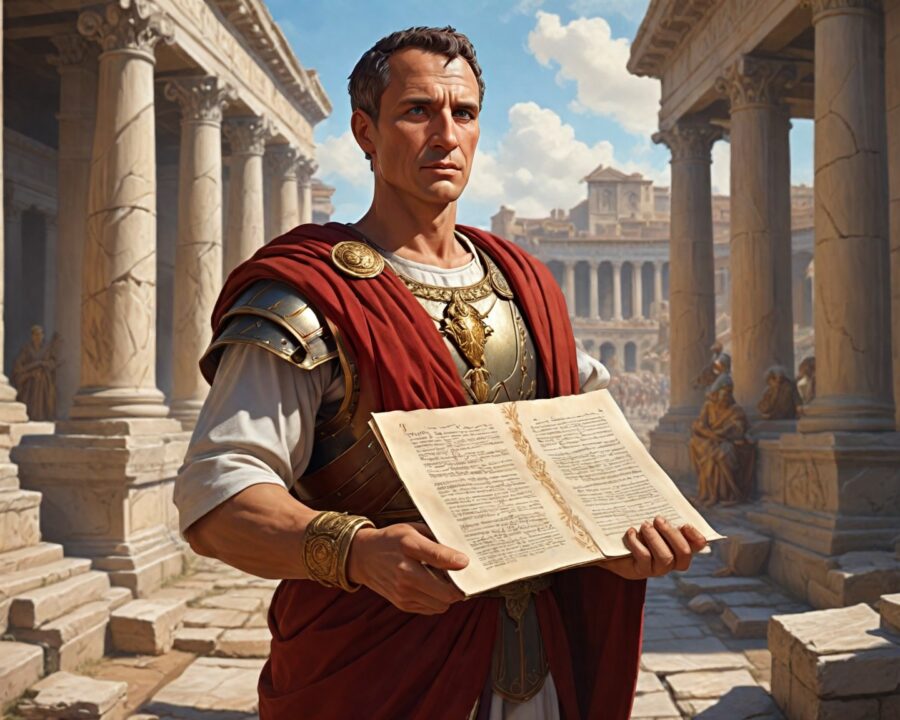
Introduction to Julius Caesar: Who Was He?
Julius Caesar stands as one of the most transformative figures in ancient history, casting a long shadow over the world of Roman politics, military strategy, and governance. Born in an era where Rome was rapidly growing from a regional power into a global empire, Caesar’s life and career reflect the tumultuous changes of the Republic into what ultimately became the Roman Empire. His influence extends beyond the battlefield and the senate chamber, reaching into the areas of literature, law, and governance, shaping the trajectory of Western civilization.
Known primarily as a military general and statesman, Julius Caesar’s impact is so profound that his name has become synonymous with leadership and political acumen. Despite the magnitude of his achievements, he met a violent end at the hands of those who once were his allies. To grasp the full scope of his life and legacy, one must delve into the complex fabric of Roman society, examining how Caesar leveraged his skills and ambitions to rise above the sandstorms of Roman politics and into the annals of history.
Early Life and Family Background of Julius Caesar
Gaius Julius Caesar was born into the patrician family gens Julia, a lineage that claimed descent from Iulus, son of the Trojan prince Aeneas, whose mother was the goddess Venus according to Roman mythology. Although the claim added a veneer of divine prestige, the Julii were not among the wealthiest or most influential patrician families in the Roman Republic. Despite this, Caesar’s family connections provided him with significant early opportunities.
Caesar was born on July 12 or 13, 100 BC, placing him in Rome during a time of social upheaval and political reform. His father, also named Gaius Julius Caesar, governed the province of Asia, while his mother, Aurelia Cotta, hailed from a prestigious banking family. Julius was fortunate to receive a high-quality education in rhetoric, history, and languages, which equipped him for public service. As a young aristocrat, he learned the art of oratory, honing his skills to eventually become one of Rome’s most persuasive public speakers.
The death of his father when Caesar was only 16 thrust this responsibility onto the young man’s shoulders. As the head of his family at such a tender age, Caesar quickly had to navigate Rome’s complex social and political networks. Significantly, his aunt Julia’s marriage to Gaius Marius, a leading political and military figure, further cemented Caesar’s link to the political arena, albeit initially on the fringes. The period was marked not only by esteemed affiliations but also by political hostilities, forcing Caesar to leave Rome when Sulla, Marius’s rival, assumed control.
Julius Caesar’s Rise to Power in Ancient Rome
Julius Caesar’s ascent to power did not occur overnight but rather as a series of calculated moves. After the fall of Sulla and the return of a semblance of peace, Caesar leveraged the restored order to build his political career. He began with modest positions such as an assistant to a prosecutor and military service in Asia and Cilicia. His demonstrated bravery and tactical acumen in the military sphere began to distinguish him from his peers.
Upon returning to Rome, Caesar turned his attention to law and politics, initially gaining the position of pontifex, a religious office that elevated his status in the Roman society. Caesar’s charm, eloquence, and shrewd political acumen helped him win key offices through the cursus honorum, the sequential order of Roman public offices. His marriage to Cornelia, Cinna’s daughter, and later to Pompeia, ambitiously connected him with influential political factions.
One of the pivotal moments in Caesar’s political career occurred during his tenure as the governor of Hispania. Here, Caesar demonstrated exceptional administrative and military capabilities, earning the loyalty and respect of both Roman citizens and provincial subjects. After concluding his governorship, Caesar returned to Rome and, through a significant political alliance with Pompey and Crassus, the First Triumvirate was formed. This alliance was instrumental in securing Caesar’s election as consul in 59 BC, further cementing his rise to unparalleled influence within Rome.
Key Achievements and Reforms Under Julius Caesar
Caesar’s tenure was marked by sweeping reforms that would lay the foundational stones of what would eventually become the Roman Empire. Perhaps his most enduring legacies are in the areas of governance, calendar reform, and his role as a military general.
In terms of governance, Caesar broke long-standing traditions by centralizing bureaucratic processes. One of his significant reforms was the overhaul of the Roman calendar, culminating in what is known today as the Julian calendar, which corrected the previous system’s inadequacies and tagged the year closer to the solar year.
Militarily, Caesar’s genius surfaced during the Gallic Wars, where his campaigns significantly expanded Roman territories all the way up to the English Channel. His comprehensive notes, under the title “Commentarii de Bello Gallico,” not only serve as historical documents but also showcase his prowess in combining diplomacy with military strategy. His conquest of Gaul increased Rome’s material wealth and cemented his status as one of history’s greatest military generals.
Despite his successes, his reforms also attracted criticism and envy, particularly from traditionalists within the Senate who disapproved of his accumulation of power. Nevertheless, his efforts in promoting public works, veterans’ rights, and the introduction of strong leadership contributed to Rome’s long-term prosperity.
The Assassination of Julius Caesar: What Happened and Why
On the Ides of March (March 15), 44 BC, Julius Caesar was assassinated by a group of Roman senators led by Gaius Cassius Longinus and Marcus Junius Brutus, leaving an indelible mark on Roman history. The assassination was the culmination of a conspiracy borne from motivations of jealousy, fear, and ideological preservation of the Republic, which many senators felt was being undermined by Caesar’s growing power.
As Caesar accrued more triumphs and honors, the political climate in Rome shifted drastically. Alarmed by Caesar’s appointment as perpetual dictator and his perceived monarchical tendencies, the conspirators believed that he intended to dismantle the Republic’s institutions, replacing them with autocratic rule. The assassination took place at the Theatre of Pompey in Rome, a calculated move conceived as a last resort to restore the Republic’s former glory.
The aftermath was chaotic, paving the way for the end of the Roman Republic and the rise of the Empire, starting with the tumultuous power struggles that ensued among Caesar’s supporters and detractors. Mark Antony, Octavian (later Augustus), and the Senate’s republicans were embroiled in conflicts that shifted Rome’s governmental structure irreversibly, proving that the assassination was a short-sighted remedy that addressed the symptoms rather than the root issues.
Impact of Julius Caesar on the Roman Empire
Julius Caesar’s assassination set the wheels in motion for the transition from the Roman Republic to the Roman Empire, a transition often marked by Caesar’s name as a turning point in Roman history. His ambition, military conquests, and reforms unified disparate Roman holdings, forging a path for future leaders.
Politically, Caesar’s centralization practices laid the groundwork for imperial rule, with Augustus, his adopted heir, capitalizing on these changes to become Rome’s first emperor. Caesar’s reforms in governance, particularly in extending Roman citizenship and altering the Senate’s composition to increase representation, were pivotal steps toward incorporating a broader and more inclusive governance model, influencing the Empire’s expansion.
Moreover, Caesar’s influence extended beyond politics into culture and language. His writings contributed to Latin literature, and the term “Caesar” itself evolved into a title for emperors not only in Rome but also in various forms worldwide, such as “Kaiser” in Germany and “Tsar” in Russia. By setting this precedent, he indelibly altered the landscape of leadership, which has been emulated throughout subsequent history.
Famous Quotes and Writings Attributed to Julius Caesar
Julius Caesar’s legacy is not only political and military but also literary. His writings, particularly those focusing on his experiences and insights, continue to be cited for their sharpness, simplicity, and eloquence. Here are some of his most famous quotes and writings:
- “Veni, Vidi, Vici” (I came, I saw, I conquered): A succinct declaration of triumph that captures both his military prowess and his ability to consolidate power rapidly.
- “Alea iacta est” (The die is cast): Uttered as he crossed the Rubicon River with his army, signaling a point of no return and the start of civil war.
- “Commentarii de Bello Gallico”: Caesar’s firsthand account of the Gallic Wars, offering detailed insights into his military tactics and strategies.
These pieces not only highlight Caesar’s intelligence but also offer invaluable firsthand perspectives on the events of his time. His writings demonstrate his skills as a communicator and leader, providing future generations insights into leadership and strategy.
Common Misconceptions About Julius Caesar Explained
The life of Julius Caesar has been romanticized, dramatized, and simplified throughout history, leading to several misconceptions. Clarifying these myths helps appreciate the true scope of Caesar’s influence and achievements.
-
Caesar was an Emperor: Despite popular belief, Julius Caesar was never an emperor. He was named “dictator perpetuo” or dictator for life but never held the title of emperor, a position formalized by Augustus, his adopted heir.
-
Purely a Military General: Many often consider Caesar solely a military leader; however, his political and social reforms have a lasting impact. His calendar reform and administrative changes were pivotal to the functioning of the later Roman Empire.
-
An Outsider to Rome: Some characterizations of Caesar suggest he was alien to traditional Roman values. However, Caesar was deeply ingrained in Roman culture and politics, skillfully navigating its structures to implement change.
By dispelling these myths, a clearer picture of Caesar’s multifaceted role as a military, political, and social figure emerges.
Lessons from Julius Caesar’s Leadership for Today
Modern leaders can draw valuable lessons from Caesar’s life, particularly in areas of ambition, adaptability, and communication.
-
Strategic Visioning: Caesar demonstrated remarkable strategic foresight, carefully aligning his military campaigns with broader political goals. Leaders today can learn from his ability to see the larger picture, balancing immediate actions with long-term aspirations.
-
Versatile Communication: His effective communication, as evidenced by the succinctness of his dispatches and military commentaries, underscores the importance of clarity and persuasion in leadership.
-
Adaptive Reforms: By reshaping Rome’s political and social structures, Caesar illustrated the necessity for leaders to adapt frameworks to better meet the demands of a changing world, a principle applicable within any organizational or national context.
In evaluating Caesar’s leadership, it’s important to acknowledge both his successes and failures as integral to deriving comprehensive lessons applicable to today’s leaders.
Where to Learn More About Julius Caesar and Ancient Rome
For those interested in furthering their understanding of Julius Caesar and ancient Rome, there are numerous avenues to explore.
| Media Type | Resource Title | Notes |
|---|---|---|
| Books | “Caesar: Life of a Colossus” by Adrian Goldsworthy | A detailed biography examining Caesar’s life and influence. |
| Academic Courses | Yale University’s “Roman Architecture” | Offers insights into Rome’s social and political systems. |
| Documentaries | PBS’s “Rome: Rise and Fall of an Empire” | Explores the broader context of Rome’s expansion and politics. |
Engaging with these resources can provide a more nuanced view of how Caesar’s life intertwined with broader historical trends.
FAQ
What was Julius Caesar’s full name?
Julius Caesar’s full name was Gaius Julius Caesar. He was named after his father, Gaius, following the Roman naming conventions.
Why is Caesar’s crossing of the Rubicon so famous?
Crossing the Rubicon River was significant because it signaled the start of civil war in Rome. It was an act of rebellion against the Roman Senate’s authority, leading to a fundamental shift in the Roman political landscape.
How did Julius Caesar rise to power in Rome?
Caesar’s rise to power was gradual, beginning with military service and gaining momentum through successful governorships, political alliances, and notable military victories, culminating in his appointment as dictator for life.
Did Julius Caesar really have an affair with Cleopatra?
Yes, Julius Caesar and Cleopatra had a well-documented affair, during which she bore him a son named Caesarion. Their relationship played a strategic alliance both politically and personally.
Was Julius Caesar born by cesarean section?
It is a common myth that Caesar was born via cesarean section. The likelihood is low, especially given that his mother survived his birth, something unlikely had the surgery taken place as survival rates were minimal until much later.
Why was Julius Caesar assassinated?
Caesar was assassinated because many senators feared his growing power and potential intentions to establish a monarchy in Rome. His assassination reflected internal resistance to autocratic rule and the preservation of republican traditions.
Recap
- Julius Caesar was born into a patrician family with historical ties to Roman politics.
- Caesar’s rise to power was marked by military and political shrewdness, culminating in his role as dictator perpetuo.
- He implemented significant reforms in governance and introduced the Julian calendar.
- Caesar’s assassination derived from fears of his perceived monarchical ambitions.
- His death marked a pivotal shift from the Roman Republic to the Roman Empire.
- Misconceptions about Caesar often obscure his true role and accomplishments.
- Modern leaders can draw valuable leadership lessons from Caesar’s life.
- Resources such as books, courses, and documentaries are available for further learning about Julius Caesar and ancient Rome.
Conclusion
Julius Caesar’s life and legacy present a multifaceted character whose accomplishments and ambitions cast him into the heart of Rome’s transformation from republic to empire. His pioneering reforms in governance, military genius, and the cause of his untimely death, offer enduring lessons in leadership, resilience, and the intricate nuances of power.
As history’s pages unfold, the shadow of Julius Caesar looms over each subsequent tale of strategy and ambition. As modern societies grapple with their paths, drawing inspiration from Caesar’s life can illuminate the intricate paths of governance, highlighting the timeless dance between authority and ambition that remains central to human history.